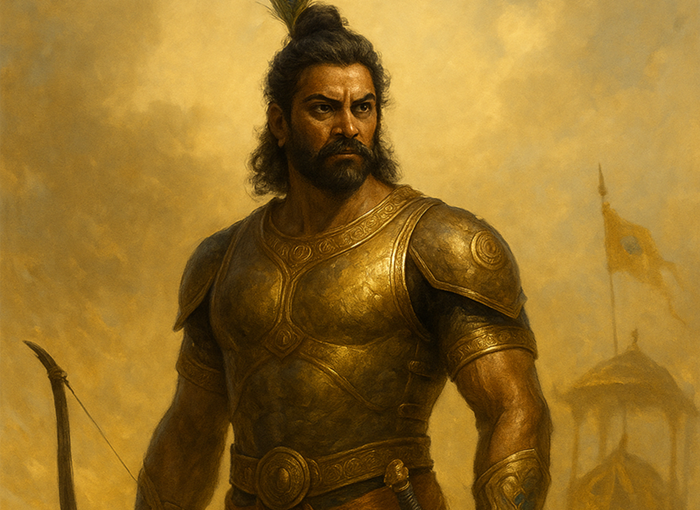
In the resplendent city of Dwarka, where the turquoise waters kissed the marble shores and the air vibrated with the wisdom of the Yadava clan, a bond blossomed not from blood ties alone, but from a shared destiny and an unspoken understanding. It was the profound kinship between Vasudeva Krishna, the very embodiment of divine strategy, and Yuyudhana, a warrior whose name would later resonate as Satyaki – the upholder of truth. Theirs was a relationship forged in the crucible of youth, amidst the clang of practice swords and the hushed discourses on dharma, a connection that would illuminate Satyaki’s path through the darkest hours of the Kurukshetra war.
Picture the vibrant tapestry of Dwarka, where young princes, inheritors of a proud warrior tradition, honed their skills under the watchful eyes of seasoned masters. Amongst them moved Krishna, even in his youth radiating an aura of preternatural wisdom and effortless grace. And by his side was Yuyudhana, a keen observer, a dedicated student, his spirit attuned to the subtle nuances of Krishna’s teachings. They sparred, not merely as trainees, but as minds engaging, their camaraderie deepening with every shared lesson in statecraft, archery, and the intricate dance of warfare. Satyaki witnessed firsthand the divine spark within Krishna, the unwavering commitment to righteousness that guided his every action. This early immersion in Krishna’s philosophy became the bedrock of Satyaki’s own moral compass, shaping his allegiances in the tumultuous years to come.
As the ominous drums of war began to echo across the land of Bharatavarsha, and the kingdoms teetered on the precipice of a cataclysmic conflict, the agonizing choices of allegiance tore families and clans asunder. Within the Yadava fraternity itself, loyalties fractured, with many powerful figures choosing to stand alongside the Kauravas, swayed by kinship or the allure of Duryodhana’s vast power. Yet, amidst this division, Satyaki stood resolute, a solitary lighthouse amidst a sea of shifting loyalties. His decision to side with the Pandavas was not born of political maneuvering or familial pressure; it was a deeply personal vow, an unwavering echo of the dharma as illuminated by his friend and guide, Krishna. To him, the Pandava cause was intertwined with the very principles Krishna espoused, a fight for righteousness against the encroaching darkness of adharma. In a world where self-interest and expediency often dictated alliances, Satyaki’s choice was a testament to the enduring power of conviction, a crimson thread of loyalty woven into the complex fabric of the Mahabharata’s unfolding drama. He chose the path dictated by his conscience, a path lit by the unwavering beacon of his faith in Krishna, even if it meant standing against the tide of his own kin.
The Kurukshetra battlefield, a vast expanse of churned earth and shattered dreams, became the stage for Satyaki’s unwavering devotion to manifest in acts of formidable valor. He fought with a ferocity born not only of his martial skill, honed in the training grounds of Dwarka, but also of his deep-seated conviction in the righteousness of the Pandava cause. He was a constant presence, a reliable warrior who stood firm amidst the swirling chaos, his loyalty a tangible force on the battlefield.
Among the numerous clashes that marked the eighteen days of war, Satyaki’s confrontation with Bhurishrava stands as a particularly poignant and fiercely contested episode. Imagine the scene: the sun beating down upon the dust-choked arena of conflict, the air thick with the cries of men and the clash of steel. Satyaki, his eyes narrowed with determination, faced his Yadava cousin, Bhurishrava, a formidable warrior who had chosen to align himself with the Kauravas. Their meeting was not merely a collision of opposing armies, but a heart-wrenching encounter between relatives, their shared lineage now a bitter reminder of the war’s divisive nature.
Arrows whistled through the air, each warrior a master archer, their skill honed to deadly precision. Satyaki moved with agile grace, his bowstring singing a taut melody of defiance as he countered Bhurishrava’s relentless assault. Yet, Bhurishrava, known for his immense strength and unwavering focus, pressed his attack. The duel escalated, the intensity mirroring the larger conflict that raged around them. It was a visceral representation of the war’s tragic reality, where once-familiar faces now stood as adversaries, bound by the unforgiving laws of dharma and allegiance.
The turning point arrived with brutal swiftness. Bhurishrava, through sheer power and relentless pressure, managed to disarm Satyaki, his bow clattering to the blood-soaked earth. The proud warrior was forced to his knees, the taste of dust and defeat bitter on his tongue. Bhurishrava, in a moment that seemed to seal Satyaki’s fate, lunged upon him, pinning him down, his intent clear. A hush might have fallen over the nearby combatants as they witnessed the apparent end of Satyaki, the loyal companion of Krishna.
But the principles of righteous warfare, however often violated in the heat of battle, still held a fragile sway. Bhima, witnessing this seemingly dishonorable act – a warrior attacking one who was disarmed and subdued – roared his disapproval, reminding Bhurishrava of the Kshatriya code of conduct. This momentary distraction, this flicker of ethical consideration in the brutal landscape of war, proved to be Bhurishrava’s undoing.
For Arjuna, ever vigilant and fiercely protective of his allies, saw Satyaki’s plight. Remembering Bhurishrava’s past transgressions, his role in the humiliation of Draupadi, Arjuna’s divine bow, Gandiva, sang a song of swift retribution. A volley of arrows, unerring in their trajectory, sliced through the air, severing Bhurishrava’s arm. The mighty warrior, though disarmed, remained unyielding in his resolve, choosing to embrace a silent penance.
Bhurishrava, his severed limb lying useless, surprisingly settled into a yogic posture, his gaze turned inward in serene acceptance. Satyaki, still reeling from the humiliation of his near defeat and mindful of Bhurishrava’s alignment with adharma, saw not a surrendered foe, but a continuing threat. With grim resolve, Satyaki drew his sword. The polished steel flashed as he approached the meditating Bhurishrava. With a swift, decisive stroke, he ended Bhurishrava’s life, the severed head falling to the blood-soaked earth, the serene expression on its face a haunting contrast to the violent act. Satyaki stood for a moment, the weight of the deed heavy upon him, before turning away to rejoin the Pandava ranks. This act, while bringing a decisive end to a formidable foe, is not without its shadows. It forces us to confront the harsh realities of war, where the lines between justice and vengeance can often blur, and where even the most loyal of hearts must make difficult and morally ambiguous choices.
Satyaki survived the Kurukshetra War, a testament to his skill, resilience, and perhaps the protective grace of his divine friend. He continued to serve the Pandavas in the years following the great conflict, his wisdom and loyalty remaining unwavering. His tale, though often overshadowed by the more dramatic narratives of the central heroes, is a crucial thread in the epic tapestry of the Mahabharata. It reminds us that the war was not fought solely by the titans, but by a multitude of courageous individuals, each contributing their strength and conviction to the ultimate outcome.
To remember Satyaki is to honor the quiet strength of unwavering loyalty, the courage to stand by one’s convictions even amidst overwhelming opposition, and the resilience of the human spirit in the face of unimaginable adversity. His life, interwoven with the divine presence of Krishna, serves as a potent reminder that true valor often lies not in the loudest roar, but in the steadfast echo of one’s deepest beliefs. His story, a testament to the enduring power of friendship and the unwavering pursuit of dharma, deserves its place in the grand recitation of the Kurukshetra’s enduring myths and karmic lessons.