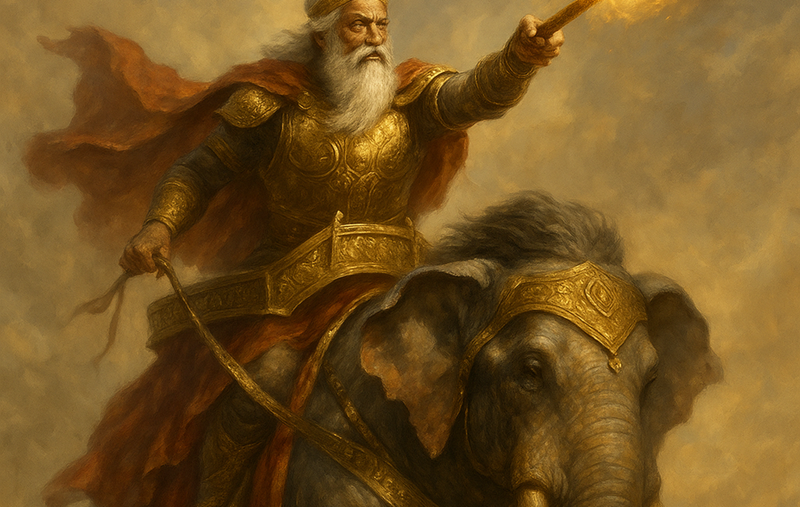
From the distant eastern kingdom of Pragjyotisha, a land where ancient magic mingled with martial might, arrived Bhagadatta – a king whose presence on the Kurukshetra battlefield was as formidable and unique as the land he ruled. Unlike the scions of the Kuru lineage, Bhagadatta’s roots lay in a realm steeped in its own rich traditions, his dominion known for its powerful elephants and skilled warriors. Imagine his journey westward, leading his army across vast terrains, his regal figure often mounted atop Supratika, his magnificent elephant – a veritable moving fortress, its ornate howdah gleaming under the harsh sun, inspiring awe and a tremor of fear in the Pandava ranks. His decision to align with the Kauravas, driven by long-standing political ties, brought to Duryodhana’s side a warrior of singular power and a force unlike any other on the plains of Kurukshetra.
Bhagadatta’s prowess transcended conventional warfare. He was one with Supratika, his massive war elephant, their movements a seamless dance of power and precision. Picture them charging into the Pandava formations – the earth trembling beneath Supratika’s immense weight, its tusks sharpened to deadly points like gleaming ivory spears, its trunk a living battering ram capable of crushing chariots and scattering infantry. And atop this majestic beast sat Bhagadatta, his eyes narrowed with battle-lust, his weapons – a formidable bow and a collection of potent javelins – held with seasoned authority. Their combined assault was a spectacle of raw power, tearing through enemy lines like a storm through dry reeds.
The clash between Bhagadatta on Supratika and Arjuna on his celestial chariot was a battle of contrasting might. Arjuna, guided by Krishna, unleashed a relentless torrent of divine arrows from the Gandiva, each shaft whistling through the air with deadly intent, seeking to pierce the elephant’s thick hide and find the king. But Bhagadatta, shielded by Supratika’s immense frame and his own skillful archery, countered each attack. Arrows rained around them like a deadly monsoon, some finding their mark on armor and flesh, others deflected or missing their intended targets in the swirling dust and chaos. Arjuna, with divine precision, targeted the vulnerable spots of the elephant, yet Bhagadatta’s control over his mount was uncanny, anticipating and often deflecting the Pandava’s strikes. The air crackled with tension as these two formidable warriors, one a master of celestial weaponry and the other a lord of terrestrial might, locked in a deadly embrace.
Seeing the relentless assault of Arjuna beginning to wear down his forces, and a glint of determination hardening in the eastern king’s eyes, Duryodhana urged Bhagadatta to unleash his most potent weapon. Bhagadatta, drawing a magnificent arrow fletched with vibrant feathers and radiating a subtle inner light, invoked the Vaishnava Astra. A hush seemed to fall over the immediate vicinity as the divine arrow, humming with celestial energy, was aimed directly at Arjuna’s chest. It streaked through the air, a luminous trail against the backdrop of the bloody battlefield, carrying the weight of Vishnu’s power. In that split second, as the Astra hurtled towards its target, Krishna, with a knowing smile and a subtle movement, pressed down on Arjuna’s chariot. The vehicle dipped lower, just enough to alter the arrow’s trajectory. The Vaishnava Astra, instead of piercing Arjuna, struck Krishna’s chest. A collective gasp arose from the Pandava ranks, only to be replaced by bewildered relief as the divine arrow merely caused the garland of celestial flowers adorning Krishna to fall gently to the earth, its divine energy harmlessly dissipated. The averted disaster underscored the immense power Bhagadatta possessed, a force that even the divine had to directly counter.
Bhagadatta continued his fierce resistance, but the relentless onslaught of the Pandava warriors, now emboldened by Arjuna’s narrow escape, began to take its toll. Surrounded and with Supratika wounded and weakened, the eastern king fought with the desperation of a cornered lion. Bhima, his mace a whirlwind of destruction, smashed through the remaining Kaurava guards protecting Bhagadatta. Seizing the opportunity, Arjuna, with a final, precisely aimed volley of arrows, struck Bhagadatta, piercing his armor and finding their mark. The mighty king slumped atop Supratika, his grip loosening on his bow. With a final, heavy sigh, Bhagadatta, the eastern monarch who had ridden his thunderous elephant onto the plains of Kurukshetra, breathed his last. Supratika, sensing the demise of its master, let out a mournful trumpet before being subdued by the Pandava forces. The fall of Bhagadatta, a king who had brought the unique might of the east to the Kaurava cause, echoed as a significant loss, further dimming Duryodhana’s hopes on the blood-soaked fields of Kurukshetra