The Last Breath of a King: Duryodhana’s Unvanquished Spirit
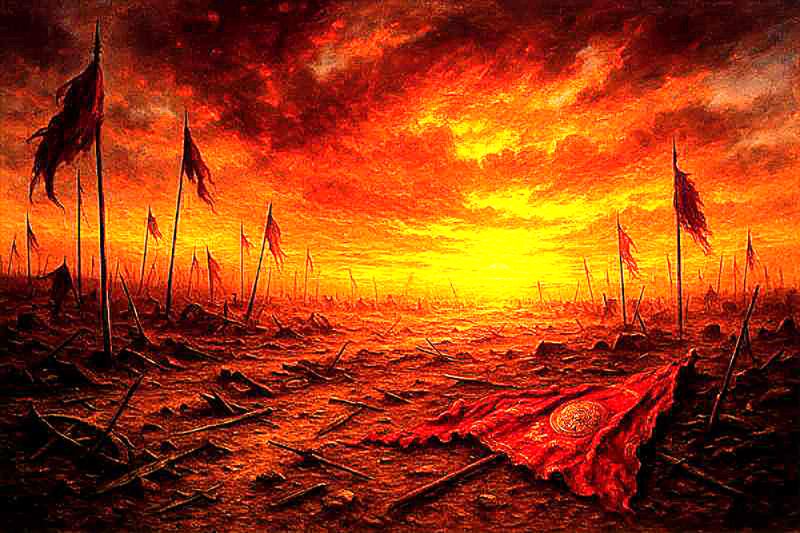
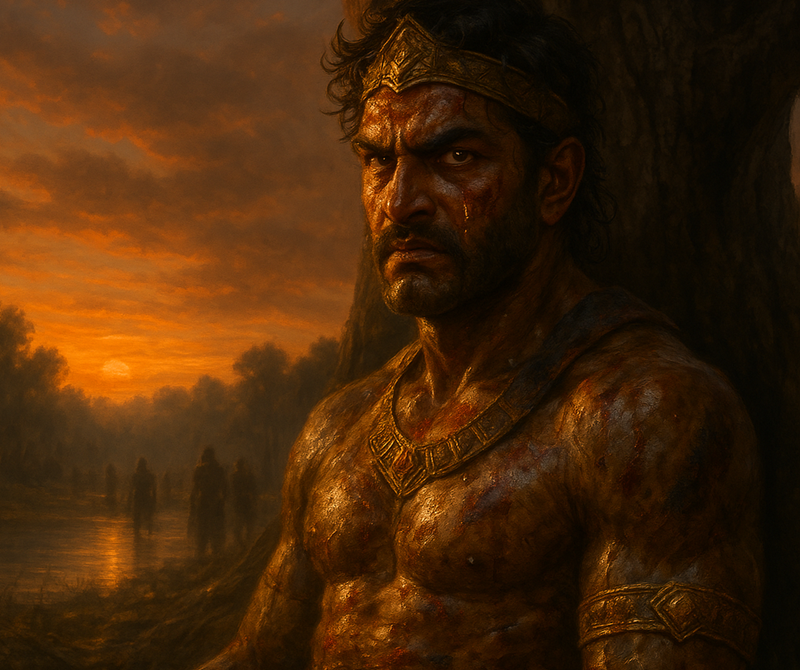
The eighteenth day of Kurukshetra ended not with a roar, but a whimper. Near the tranquil Dwaipayana lake, amidst the stench of death, lay Duryodhana, the King of Kauravas, his body a shattered vessel, propped against a venerable tree. His breath came in ragged gasps, but his eyes, though clouded with pain, still burned with an unyielding pride. Before him stood the Pandavas, their victory tasting like ash, and Lord Krishna, serene amidst the devastation.
“I have lived as a beloved king!” Duryodhana’s voice, though a mere rasp, resonated with the defiance of a lion. “I ruled a prosperous kingdom, overflowing with joy and abundance! My family, my brothers, my cherished friends were by my side! And today, I ascend to Swarga, to join them!” He spat a mouthful of crimson, his gaze, sharp as a broken spear, piercing Yudhishthira. “I pity you, Dharma-raj! You will rule a land of corpses, of mourning wives and mothers, with only your brothers and wives left. You will never know the true pleasure of ruling amidst loved ones. Go, Yudhishthira, rule your kingdom of vultures!” His words, laced with venom, were a final, bitter triumph.
His gaze, now burning with a dying man’s incandescent rage, fixed upon Krishna. “It is because of you, Keshava, I lie here, defeated! You, who preached ‘Dharma’ to me, yet led these Pandavas down the path of ‘Adharma’ countless times! Was it Dharma when Pitamah Bhishma, our revered grandfather, was slain by deceit? Was it Dharma when Guru Drona, my beloved teacher, was killed through falsehood? Was it Dharma when my dearest friend, Suryaputra Karna—the son of the Sun God—was sinfully struck down by your beloved friend Arjuna, who, by your grace, is now ironically hailed as the greatest warrior? And today, you again guided these Pandavas against me! Bheema, against every sacred rule of Gada (mace) fighting—the weapon of Lord Hanuman and himself—attacked me below my waist on your direction!”
Duryodhana coughed, a violent spasm tearing through him, spewing more blood. “I never sought your favour, but how could you encourage such unrighteous acts against those who not only respected you but believed you were Narayana—the Eternal God on this earth? Yet, the world will know you as God, for history will be written by these sinful, unrighteous Pandavas! What a shame!” His body convulsed, his soul visibly struggling to break free.
Krishna’s calm smile did not waver. “Son of Gandhari, you fought like a great Kshatriya (warrior). Do not sully that honour by whining about Adharma. Where was your logic of Dharma when your own clan’s daughter-in-law, Draupadi, was dragged, disrobed, and humiliated before everyone? Who ordered Dushasana to commit that heinous act?”
Yudhishthira, shattered by Duryodhana’s words and Krishna’s stark reminder, bent his gaze to the earth, unable to meet the dying king’s cynical eyes. He himself was deeply heartbroken, knowing Bheema’s blow was unrighteous, yet he stood his ground as the Pandava leader. Krishna, understanding both Duryodhana’s accusatory gaze and Yudhishthira’s profound shame, continued. “Why did these great warriors and noblemen of the Kuru clan stand there, heads bowed, allowing that greatest sin in history to befall a woman? How could a court full of the greatest men on earth permit such a dishonour? Gandhariputra, they all embraced their Karma, their defeat, and their death with grace and Kshatriya Dharma. You too understand that this was bound to happen as a result of your own Karma. Embrace it; it will ease your last journey.” All the Pandavas, listening to Keshava, bowed their heads in shame; the woman subjected to such dishonour was their own beloved wife, Draupadi.
Duryodhana, in immense discomfort, tried to speak, but Krishna’s voice cut through the silence. “Greatest King of the Kuru clan, let us not argue on warfare and associated Dharma, for the brutal slaying of Abhimanyu—Arjuna’s 16-year-old son—trapped and butchered inside the formidable Chakravyuh (a multi-tiered, complex army formation, considered invincible) is fresh in our memory and will forever be regarded as a heinous act in the history of mankind. What do you say to that?”
Duryodhana, with a final, agonizing effort, pulled his body lower, his head finding rest against the tree. He gathered all his remaining strength. His right hand, slick with his own blood, slowly rose into the air, splashing crimson droplets. He extended three fingers. Each of the Pandavas—Bheema, Arjuna, Nakula, Sahadeva, and Dharma-raj Yudhishthira—believed he was negating Krishna’s every statement. Arjuna looked at Yudhishthira, hoping for solace, but Yudhishthira, grief-stricken by both Duryodhana’s words and Krishna’s truths, could not utter a sound.
Arjuna, ever the loyal friend, turned to Duryodhana. “Brother Duryodhana, Keshava is correct. Accept it and find peace in your last breath.” Duryodhana’s eyes, filled with tears of both pain and fierce rage, met Arjuna’s, then shifted to Krishna with a knowing, sarcastic glint. Krishna gently placed his hand on Arjuna’s shoulder. “Parth (Arjuna, son of Indra), the eldest of the Kauravas is not negating me. He is pointing to the three things which, had he done them, would have let him win this war against you. Am I right, Dhritarashtraputra (son of Dhritarashtra)?” Krishna asked Duryodhana. Duryodhana nodded, a sigh of profound relief escaping him as his hand, finally lifeless, fell to the ground, covered in his own blood, like a broken branch from a mighty banyan tree, axed down.
The Pandavas looked at Lord Krishna, their faces etched with inquisitive wonder. Krishna smiled, raising his index finger. “First,” he began, “if he had built an impenetrable fort and wall around Hastinapur during your thirteen years of exile, the war itself could have been avoided. Hastinapur would have forever been inaccessible, unconquerable.” The Pandavas looked at Duryodhana, a flicker of understanding, even awe, in their eyes. Duryodhana, in his agony, looked back, his gaze fixed solely on Arjuna, a profound, lingering sorrow in his eyes.
“The second,” Krishna continued, “was convincing Vidura—the wisest man, the embodiment of Dharma, and the half-brother of Dhritarashtra and Pandu—to side with the Kauravas in the war. Regarded as Dharma-raj himself, Vidura could have helped Duryodhana counter all my strategies.” (Vidura had famously supported the Pandavas, cutting ties with the Kauravas after Draupadi’s humiliation).
Yudhishthira, ever the one to ponder the intricacies of destiny, murmured, “Had Vidura supported Duryodhana, the result indeed would have been different.” But Arjuna, his devotion to Krishna absolute, quickly countered, “Keshava, I believed you were Parbrahma (the eternal God)! Even if Lord Vidura had supported the Kauravas, you would have ensured my victory, wouldn’t you, my friend?” To this, Lord Krishna merely smiled, a knowing, enigmatic expression.
“And the third,” Krishna revealed, “was appointing Ashwatthama—the son of Guru Dronacharya—as his army commander after Drona’s death, ahead of Karna.”
Bheema, who had been listening, tired and wounded from his fight with Duryodhana, being helped by Sahadeva, let out a mocking, incredulous laugh. “Seriously, Keshava? I, Bheema, killed all the Kauravas with my bare hands and my mighty mace! Arjuna killed Bhishma and Karna, the greatest warriors ever born! We reduced eleven Akshauhini armies (a massive army unit, roughly 5.5 million soldiers) of the Kauravas to mere handfuls! What difference could Drona’s son, Ashwatthama, have possibly made?” Bheema, summoning his last reserves of strength, roared, “Let me find him now and finish him before Duryodhana, to show him he could never have won! Then his departing soul will be convinced of his utter defeat!”
Duryodhana’s eyes snapped open, blazing with a final surge of anger at Bheema’s ignorant boast, then turned to Lord Krishna, a look of profound sarcasm passing between them—a silent understanding of Bheema’s foolishness.
Arjuna, the closest and most beloved of Krishna’s companions, looked at him in confusion. Krishna, with the infinite wisdom that had always guided Arjuna, explained, “Indraputra, Drona performed rigorous Tapasya to please Lord Shiva for a son as valiant as himself. Ashwatthama is a Rudra-born, manifesting parts from Krodh (Anger), Kama (Love), destructive Rudra, and Yama (Death). Duryodhana believed that such a Rudra could have countered my very presence in this war.”
Yudhishthira, his face etched with sudden worry, exclaimed, “He is still alive! And we do not know where he is! Vasudevanandan (son of Vasudeva), if this belief of Duryodhana is correct, how can we say the war is truly over and be at peace when Ashwatthama is still out there?”
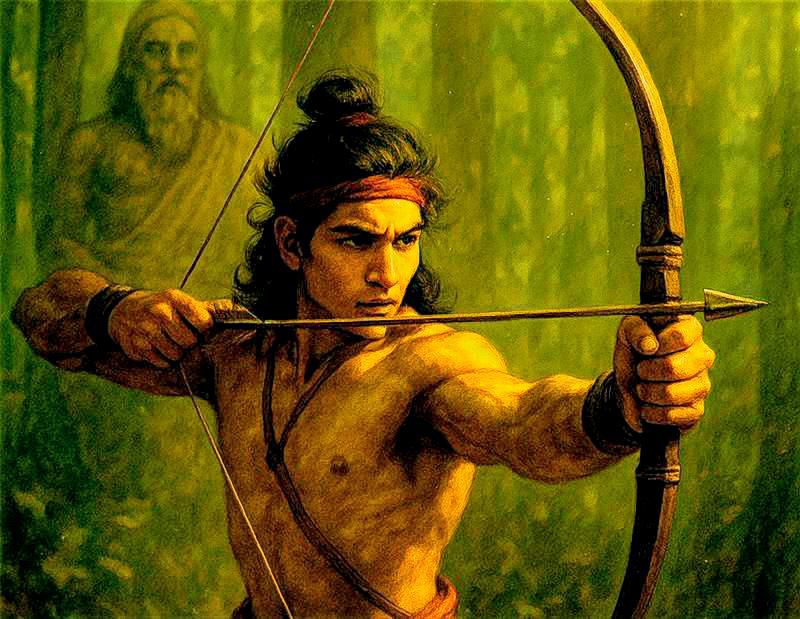
Duryodhana, in utter pain, offered a faint, knowing smile and finally closed his eyes. Krishna gently placed a hand on Yudhishthira’s shoulder, calming him, and with his eyes, directed him to allow Duryodhana to depart alone in his last moments. Sahadeva and Nakula helped a weary Bheema to stand. Arjuna slowly shouldered his divine Gandeev—the celestial bow crafted by Brahma, the Creator.
Yudhishthira gazed at Duryodhana, a figure of blood, mud, and tears. His heart was heavy, tears streaming down his face. He looked at the darkening forest surrounding the lake, knowing the howling jackals awaited, and the vultures circled ominously above, patiently anticipating the eldest Kuru’s death. He yearned to help his cousin, to offer solace, to somehow bring him back from the brink, but he knew Duryodhana would never accept it. His legs weakened, and he was about to fall when Arjuna swiftly caught him. Krishna helped Arjuna support Yudhishthira and spoke, his voice firm yet compassionate:
“Calm yourself, Yudhishthira. I understand your profound grief, but now is not the time for personal sorrow. You must embody the King. Embrace the Dharma of a Kshatriya monarch. There are millions who will be looking up to you in this time of extreme grief after the sacrifices of war. You cannot be weak at this moment. You must hold the entire kingdom together, console your people, strengthen their resolve, and illuminate their path towards truth, Dharma, prosperity, and enduring hope.“
Yudhishthira, with a visible effort, straightened, finding strength in Krishna’s divine words. He folded his hands, bowing his head to his fallen cousin. “Be in peace, my brother.” Tears continued to fall freely. Arjuna, Nakula, and Sahadeva followed his lead. Krishna then gently led them towards their chariots. Bheema, assisted by Sahadeva and Nakula, was helped into Arjuna’s chariot. As the Pandavas, with Lord Krishna, departed, the Kuru King lay alone in the deepening twilight, his final breaths exhaled, while the waiting scavengers descended upon the silent battlefield.