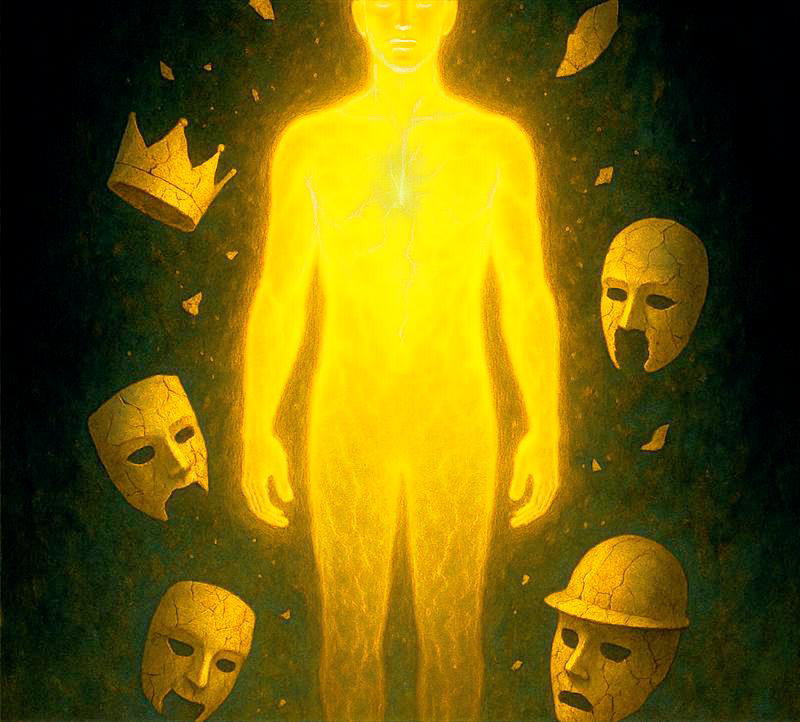
Is This You?
The email arrived on a Tuesday morning. “Your role has been eliminated.” Just like that, a core piece of your identity vanishes. For years, the first thing you said at parties was, “I’m a [Job Title] at [Company Name].” Your LinkedIn profile was a monument to your career. Now, when someone asks, “What do you do?” a feeling of panic and shame rises in your throat. You feel like a failure, like you’ve lost not just an income, but your very self.
If a single event can shatter your sense of worth, was that worth really yours to begin with? Ancient wisdom offers a radical and liberating alternative. Your true self is something no one can ever take away from you.
The Ancient Anchor
In the Bhagavad Gita (Chapter 2, Verse 23), Krishna gives Arjuna a profound lesson about his true nature, a nature that is immune to worldly change:
नैनं छिन्दन्ति शस्त्राणि नैनं दहति पावकः |न चैनं क्लेदयन्त्यापो न शोषयति मारुतः ||
(Nainam chindanti shastrani nainam dahati pavakah |Na chainam kledayantyapo na shoshayati marutah ||)
Translation: Weapons cannot cut It (the soul), nor can fire burn It. Water cannot wet It, nor can the wind wither It. lets just put for once – Soul as Yourself here.
This isn’t just poetry. It’s a declaration of your invincibility. Your core self—your Atman—is eternal and untouchable. It cannot be promoted, demoted, hired, or fired. It is completely independent of your external circumstances.
How This Philosophy Unfolds in the Ancient Texts
Our stories repeatedly show heroes discovering this untouchable core when their worldly identities are stripped away.
First, there is the powerful story of Nachiketa from the Katha Upanishad. This young, curious boy finds himself in the realm of Yama, the God of Death. Impressed by the boy’s courage, Yama offers him any worldly boon he desires. These include vast wealth, a long life, beautiful companions, and even entire kingdoms. He offers him everything our society tells us to chase. Nachiketa rejects it all. He asks for the one thing that truly matters: knowledge of the Self. He chooses to understand the permanent reality within him over any temporary, external reward.
Next, look at the Pandavas during their 13-year exile. One day they were princes living in a palace, their identities defined by royalty and power. The next, they were homeless wanderers in the forest, with nothing to their names. This brutal trial stripped them of their titles, wealth, and status. It forced them to discover who they were without their royal privilege. They had to rely on their inner skills, their character, and their bond with each other. They entered the forest as princes. They emerged as self-reliant, wise kings. Their strength was forged in the fire of loss.
Finally, the journey of Siddhartha Gautama is the ultimate example. He was a prince who had everything: a palace, luxury, a family, and a future as a king. His identity was set. But he saw that all of it—wealth, health, and life itself—was temporary. He voluntarily renounced his princely title and all his possessions to seek a truth that could not be lost. His transformation from Prince Siddhartha into “the Buddha” is a story of shedding a limited, external identity. He realized a universal, internal one.
The Modern Disconnect
Our society has almost completely replaced “who you are” with “what you do.” Your job title has become a social shorthand for your value, your intelligence, and your worth. We build our identities on these fragile foundations—our company’s brand, our salary, our position on the corporate ladder. Is it any wonder we feel so anxious and insecure? We have tied our self-worth to things that are, by their very nature, impermanent.
Wisdom at Work
How can we start living from our untouchable core?
- In Your Career/Hustle: See your job as something you do, not something you are. This frees you to take creative risks without your self-worth being on the line. If you get laid off, it’s a painful event, but it’s not an indictment of your character. Your skills, your creativity, and your resilience are yours to keep, and you can take them anywhere.
- In Your Relationships: When you know your worth isn’t tied to your job, you connect with people more authentically. You stop seeing others as networking opportunities and start seeing them as human beings. You become more interested in their character than their career.
- For Your Mental Health: This is the ultimate shield against burnout and anxiety. It creates a stable, peaceful center within you that the ups and downs of life cannot shake. You find validation from within. It does not come from your boss’s approval or the number of likes on your post. This is the definition of resilience.
Modern Sages
The world’s great minds consistently point to this inner reality.
- The Indian sage Ramana Maharshi taught that the most important spiritual practice was the inquiry “Who am I?” He guided people to look beyond the transient layers of identity. These include the body, the name, and the job. This guidance helps to find the silent, unchanging consciousness that is their true Self.
- Viktor Frankl, a psychiatrist and Holocaust survivor, wrote in “Man’s Search for Meaning” about the resilience of human spirit. He stated that even in a concentration camp, everything was taken from a person. However, the “last of the human freedoms” was the ability to choose one’s own attitude. He discovered that survivors could connect to an inner source of meaning. Their horrific circumstances could not affect this inner source.
- Even the actor Jim Carrey has spoken about his journey beyond fame. He realized that the identity of “Jim Carrey, the movie star” was a construct. He found peace in understanding that his true self was not the role he played. It was something much vaster and more fundamental.
Your First Step
Try this simple exercise tonight. Take five minutes. Sit quietly and ask yourself, “Who am I without my job?” Write down the answers. Don’t use your name, your relationships (e.g., son, daughter), or your possessions. Focus on your inherent qualities. Are you curious? Resilient? Kind? Creative? A good listener? A problem-solver? This isn’t just a list. This is the beginning of a map back to your true, unshakable self. This is the “You” that can never be eliminated in an email.