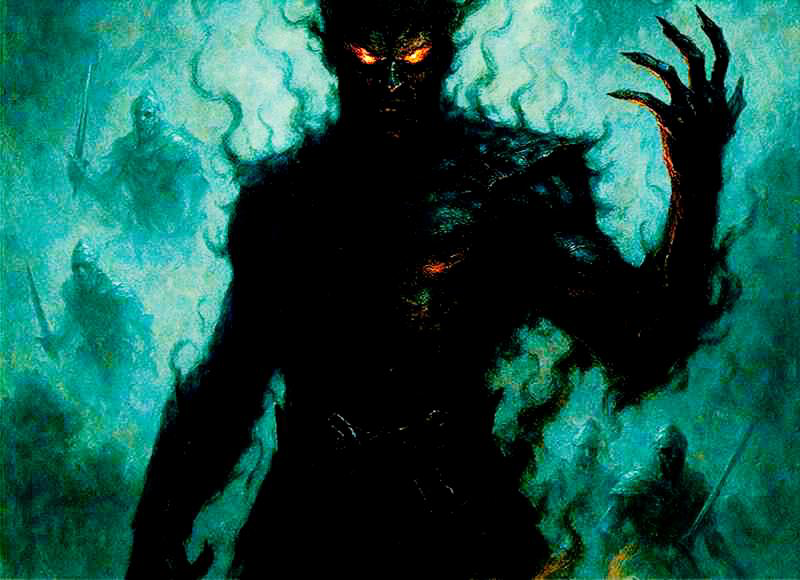
From the shadowy fringes of the battlefield, where the veil between reality and illusion thinned, Alambusha emerged. He was a Rakshasa warrior, his allegiance lying with the Kauravas. His might was woven not from steel and muscle alone, but from the ethereal threads of dark magic. Unlike the kings and princes who rode into battle with proud banners, Alambusha moved in darkness. Gleaming armor did not adorn him. He was a creature of the night. Unsettling winds often heralded his presence. The creeping tendrils of fear accompanied him. He emerged from the very shadows. His form flickered like heat haze. His eyes were twin embers burning with an arcane light. This light spoke of powers beyond mortal comprehension. His decision to fight for Duryodhana was sealed by ancient Rakshasa pacts. It could also be due to a shared delight in sowing chaos. This decision brought to the Kaurava ranks a force both unpredictable and terrifying. He was a master of illusion capable of twisting the very fabric of perception on the battlefield.
Alambusha’s warfare was a macabre spectacle of deception. He conjured phantoms that preyed on the deepest fears of his enemies, turning courage into paralysis. Bhima, the earth-shaker, his mace usually a harbinger of doom, suddenly faltered. Before him stood spectral forms of his beloved brothers. Yudhishthira and Arjuna appeared with hollow eyes. Their voices were laced with accusations of his recklessness. Bhima roared in confusion and anguish, his mighty blows passing harmlessly through these ethereal mockeries. Sweat beaded on his brow. Doubt gnawed at him. Were these truly illusions? Had his rage somehow manifested his deepest fears? In that moment of hesitation, true Kaurava warriors surged forward. Bhima’s bewilderment emboldened them. Their attacks landed with brutal force. They exploited the openings created by Alambusha’s phantom kin. Bhima shook his head to clear the fog of fear. He finally recognized the cruel trickery. However, it was not before he sustained grievous wounds. The phantom brothers had served their purpose as deadly distractions.
Arjuna, with his divine vision and the celestial Gandiva, faced Alambusha with a keener awareness. However, the Rakshasa’s artistry of illusion was a persistent torment. A Kaurava chariot charged, its pennants snapping in the wind. Arjuna loosed a volley of arrows. Each was aimed with deadly precision. He only witnessed the chariot dissolve into shimmering motes of light. In its place, a grotesque beast appeared. It had gnashing teeth and fiery eyes. Its roar was a chilling assault on the senses. Arjuna’s celestial steeds reared in terror. They nearly unseated him. Krishna, ever the guiding force, steadied the chariot. His calm voice cut through the illusory chaos. He reminded Arjuna to focus on the subtle disruptions in the magical weave. Arjuna listened to the divine counsel and adjusted his aim. He no longer targeted the phantoms themselves. Instead, he focused on the almost imperceptible flicker in the air. It was the faint distortion that betrayed Alambusha’s presence. His arrows had a focused intent. They sliced through the illusions. This forced the Rakshasa to reveal his shadowy form. The Rakshasa then melted back into the deceptive veil. Their battle was a constant struggle. It was a fight between divine perception and dark sorcery. This was a testament to Arjuna’s unwavering focus against Alambusha’s insidious powers.
The encounters between Alambusha and Ghatotkacha were a breathtaking spectacle of opposing mystical forces unleashed under the cloak of night. The battlefield pulsed with an eerie, pulsating luminescence as they clashed. Ghatotkacha grew to an immense, shadowy form that blotted out the stars. His roars echoed like thunder through the darkness. He tore through Alambusha’s illusions with brute magical force. His massive limbs swatted away phantom armies as if they were mere insects. Alambusha retaliated. He conjured nightmarish creatures—writhing, multi-limbed horrors with glowing eyes and razor claws. Their spectral forms lashed at Ghatotkacha’s colossal frame. They drew ichor-like fluids that hissed upon contact with the earth. Ghatotkacha relied on his inherent Rakshasa resilience. The raw power coursing through his veins helped him withstand the assault of shadows and fear. His own dark magic was a potent counter to Alambusha’s illusions. Their battles were a chaotic maelstrom of raw power and deceptive artistry. Each sought to overwhelm the other with their unique brand of mystical warfare. Often, their clashes ended in a temporary stalemate. The night air was thick with residual magical energy.
Alambusha’s reign of illusion and terror ended not through a grand confrontation with a seasoned warrior. Instead, it ended through the unexpected clarity and unwavering courage of Abhimanyu, Arjuna’s youthful son. Amidst a swirling vortex of Alambusha’s phantoms, spectral warriors advanced with terrifying cries. Abhimanyu rode with a focused intensity. This focus belied his age. While seasoned veterans struggled to discern reality from illusion, Abhimanyu’s gaze remained sharp, his mind unclouded by fear. He saw the subtle inconsistencies, the fleeting moments where Alambusha’s control wavered. His bowstring sang. His arrows, guided by an almost preternatural intuition, flew not at the illusory hordes. Instead, they flew directly towards the source of the magic. One arrow pierced Alambusha’s shadowy shoulder, disrupting his concentration, causing his phantom legions to flicker and dissipate. A second arrow followed, finding its mark in the Rakshasa’s chest. Alambusha shrieked. It was a sound of pure, unearthly agony. His flickering form dissolved into wisps of dark smoke. The smoke spiraled upwards and vanished into the night. Abhimanyu, his youthful face resolute, pierced the heart of the illusion. He silenced the shadow weaver. This brought a fragile sense of clarity back to the war-torn field. Alambusha, the master of nightmares, was defeated. His dark arts were overcome by the unwavering spirit of a young hero. His keen perception led to the hero’s victory. His passing marked the definitive silencing of a chilling whisper on the Kurukshetra plains.