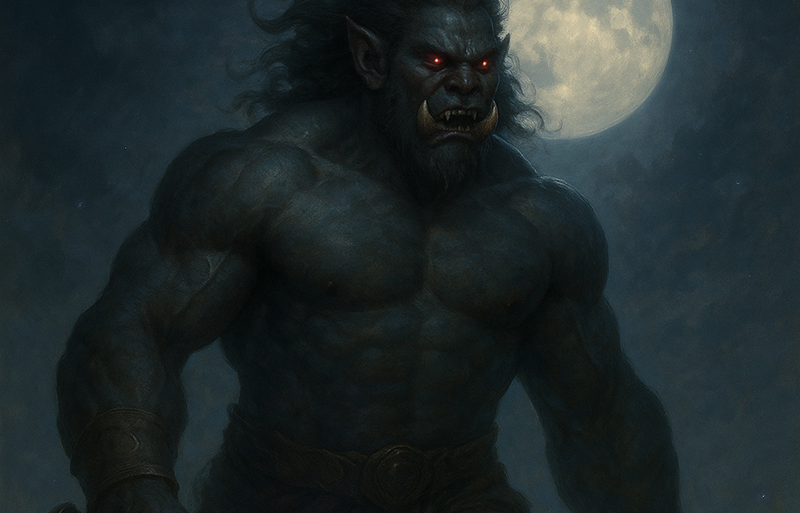
Beyond the familiar lineage of the Kuru clan, amidst the whispers of forest dwellers and the echoes of Rakshasa roars, a unique hero emerged onto the Kurukshetra stage: Ghatotkacha. Born from the union of the mighty Pandava Bhima and the Rakshasi princess Hidimba, his very existence was a testament to the interwoven destinies of humans and the mystical races. Unlike the princes raised in the refined courts of Hastinapur, Ghatotkacha’s upbringing was steeped in the raw power and untamed magic of the forests. Imagine his youth, not amidst scholarly debates and courtly etiquette, but under the tutelage of his mother, learning the secrets of the night, the whispers of the ancient trees, and the formidable strength that coursed through his Rakshasa veins. His form, a stark departure from the human warriors, was a visible manifestation of his dual heritage, a shadowed might waiting to be unleashed.
While his lineage set him apart, it was his heart, fiercely loyal to his father and his Pandava uncles, that defined his role in the unfolding drama of the Mahabharata. He held no ambition for kingdoms or earthly power; his allegiance was rooted in the profound bond of family, a primal connection that transcended the complexities of political alliances. When the call to arms echoed across the land, Ghatotkacha arrived not as a mere ally, but as a force of nature, his Rakshasa form inspiring both awe and fear in the ranks of the opposing army. His arrival on the Kurukshetra plains – a towering figure, his eyes gleaming with an otherworldly intensity, his very presence a tangible manifestation of the wild energies of the forest brought to the heart of the conflict. He was an unconventional warrior, unbound by the traditional rules of warfare, his strength drawn from a source both mystical and deeply personal.
Though he participated in numerous skirmishes, it was during the fourteenth night of the war, a night shrouded in darkness and desperation, that Ghatotkacha’s shadowed might shone most brilliantly. With Arjuna embroiled in a fierce battle far from the main Pandava forces, the Kaurava ranks, under the tactical command of Karna, pressed their advantage. Karna, wielding the formidable Vasavi Shakti – a divine spear he had reserved for Arjuna – posed a grave threat to the Pandava efforts. It was in this critical juncture that Ghatotkacha unleashed his full Rakshasa powers. The battlefield was plunged into an eerie twilight, punctuated by the grotesque and terrifying illusions conjured by Ghatotkacha. Rakshasas, both real and spectral, swarmed the Kaurava ranks, sowing chaos and fear. Ghatotkacha himself, grew to an immense size, became a terrifying spectacle, his roars shaked the very earth. He targeted Karna directly, their conflict a clash between mortal skill augmented by divine weaponry and raw, untamed magical power.
Karna, a warrior of unparalleled might, met Ghatotkacha’s onslaught with his celestial arsenal. Arrows imbued with divine energy clashed against Rakshasa illusions, the night sky lit by the fiery trails of their combat. Yet, Ghatotkacha’s relentless assault and bewildering magic began to overwhelm even the mighty Karna. Duryodhana, witnessing the devastation wrought by Bhima’s son and fearing for the collapse of his forces, implored Karna to use the Vasavi Shakti. Karna, bound by his loyalty to Duryodhana and seeing the immediate threat Ghatotkacha posed to the entire Kaurava army, had no choice but to unleash the divine spear he had so carefully guarded for Arjuna.
Ghatotkacha, in his colossal Rakshasa form, lunging towards Karna, and the Suryaputra, with a heavy heart, unleashing the Vasavi Shakti. The divine spear, a streak of incandescent energy, pierced Ghatotkacha’s chest. The Rakshasa warrior, with a final, earth-shattering roar, fell. However, even in his death, Ghatotkacha’s purpose was served. The Vasavi Shakti, the weapon destined for Arjuna, had been used against him, saving the Pandava’s greatest warrior from certain doom. Moreover, his massive body, as it crashed to the ground, crushed a significant number of Kaurava soldiers, adding a final, brutal blow to their ranks in that dark hour.
Ghatotkacha did not survive the Kurukshetra War, his tale a poignant reminder of the sacrifices made by those who stood with the Pandavas. Though his life was relatively short in the grand narrative, his impact was profound, particularly during that fateful fourteenth night when his unique powers and ultimate sacrifice saved Arjuna and significantly weakened the Kaurava forces. His story underscores that valor comes in many forms, and that even those from seemingly unconventional backgrounds can play crucial roles in the cosmic dance of dharma and karma. To remember Ghatotkacha is to honor the fierce devotion that transcended lineage, the shadowed might unleashed in the defense of righteousness, and the ultimate sacrifice made for the greater good – a powerful echo of devotion resonating from the heart of the Kurukshetra’s darkness.